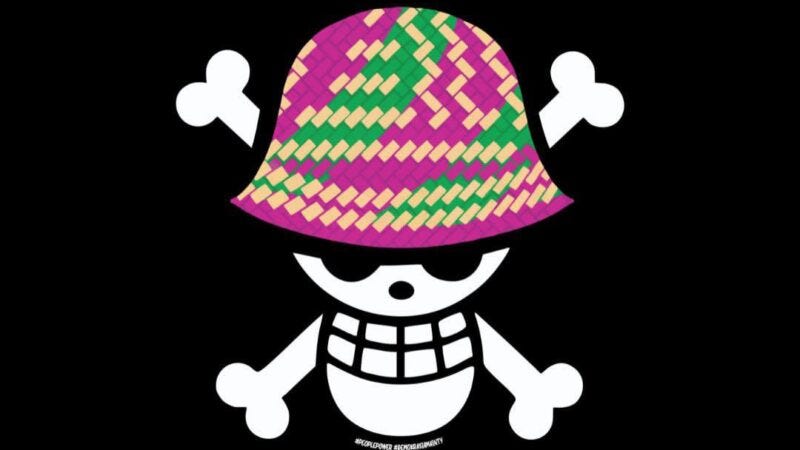


The Strawhat Jolly Roger: Gen Z’s symbol of freedom
Written by Tanzir Ahmed
A pirate flag donning a skull wearing a straw hat flies in front of the Nepali parliament as it burns down. A pirate flag, better known as a jolly roger, generally represents terror on the seas and subversives, but for the young Nepalis it represents freedom from a corrupt government. This flag originates from the manga One Piece, flown by the Strawhat Crew which Gen Z has co-opted. I’ve read the currently 1167 chapters released, so obligatory spoiler warning. The One Piece world consists of thousands of islands making seafaring the main mode of transport. The world of One Piece is led by an oppressive military regime called the World Government that sees its member states as sources of money, manpower and other resources. The Strawhat Crew led by Monkey D. Luffy who wishes to become the King of the Pirates; the freest man in the world and to find the One Piece. The World Government’s most powerful government officials are hundreds of years old and its member states are generally led by corrupt people. An average adventure involves Luffy and his crew docking at an island becoming friends with the locals and proceeding to free them from their corrupt rulers. In short, “the flag symbolizes Luffy’s quest to chase his dreams, liberate oppressed people, and fight the autocratic World Government.”, as described by CNN.
It is not just the youth of Nepal who are protesting. Across the world, Gen Z (born between 1997-2012) is resisting the rule of old leaders who are detached from the plights of their youth. The most egregious example is Paul Biya (92), who got re-elected in the Cameroonian presidential election held on 12 October 2025. He has been in power for 40 years while Cameroon’s population’s median age is 18.66 years. It is not a surprise that in the digital age where anime and manga are very popular among Gen Z that the message of freedom and rebellion against the status quo that One Piece embodies is equally popular among the youth. With One Piece being sold globally its message also transcends borders visible by protestors across countries such as Indonesia, Nepal and Madagascar flying the flag.
Indonesia
Indonesia, being a collection of islands of various sizes itself, naturally connects with the fictional world of One Piece. Thus, it only makes sense that the Gen Z of Indonesia relate to the Strawhat Crew. The first instance of the jolly roger being flown was in late July 2025 in Indonesia where truck drivers were protesting the banning of ODOL (Over Dimension Overload) trucks by the government. In the leadup to the 80th anniversary of Indonesia’s independence the leader of Indonesia Prabowo Subianto, a 74 year old ex-military general, called for people to fly the Indonesian flag on independence day. Some people chose to fly the Strawhat jolly roger either with the Indonesian flag or on its own as a sign of protest against the government. People perceive the government as failing them and becoming increasingly authoritarian. The protests in Indonesia are rather sporadic. Unlike the next two examples, I don’t think Prabowo’s rule is threatened by the protests, unless of course he really cracks down hard on civil society.
Nepal
Over 50% of Nepal’s population is under the age of 25. Anime, manga and social media are very popular among this demographic. Nepal’s government, formed in 2024, was led by now former prime minister K. P. Sharma Oli who is 73. In the summer of 2025, Tiktoks of children of government officials and their lavish spending went viral with them being referred to as Nepo Babies. Then on the 4th of September the Nepali government banned the majority of popular social media sites such as TikTok, YouTube, Instagram and others. Ostensibly because the Nepali government wanted to force them to pay a new digital tax, but likely also to prevent more criticism of the government. With over 48.1%[1] of the total population having social media this did not go over well with the Nepali population. The Nepalis used VPNs, flyers and QR codes to bypass the Social Media ban and organized themselves on Discord channels and Instagram. By the 8th of September massive protests broke out in Nepal’s capital Kathmandu. On the 9th of September, Nepalis burned down the parliament and forced the prime minister to flee. Sushila Karki, a former chief justice of the Nepali supreme court, was picked by a poll on social media platform Discord to become interim prime minister for 6 months when elections will usher in a new government on March 5th 2026.
On the 28th of September 2025 protests started in Madagascar, where, despite having some of the most valuable minerals in the world, over 80% of the population live below the international poverty line and over 50% are under the age of 20. Young people took to the streets to protest the frequent power outages and water shortages, lack of jobs and widespread poverty. Rajoelina, after two weeks of protests, dissolved the government on October 6th , appointing a new prime minister with military background. By this point, however, public dissatisfaction with Rajoelina had grown to the point that many were calling for him to step down.
Rajoelina has a rather interesting political journey himself. He became the mayor of the capital Antananarivo in 2007. In 2009 he mobilized the people to protest the policies of then president Marc Ravalomanana. The special forces army unit CAPSAT after months of continuous protesting sided with Rajoelina and overthrew the president. Rajoelina was the head of the new High Transitional Council (2009-2013). In 2018 he won the presidential election succeeding Hery Rajaonarimampianina. In 2023 he was reelected once again however the opposition mostly boycotted the vote due to Rajoelina banning political rallies and opposition gatherings.
On the 12th of October 2025 CAPSAT took over the capital facing no resistance from the protestors. On the 13th of October CAPSAT had taken over the military and replaced the chief of staff who was a Rajoelina ally with somebody from CAPSAT. It was later revealed that on the 12th of October the prime minister and Rajoelina fled the country. Rajoelina has allegedly been evacuated by the French, something Emmanuel Macron refused to comment on. It is still unclear where Rajoelina has fled to. The commander of CAPSAT; Michael Randrianirina, became the interim president. The parliament impeached Rajoelina. On the 17th of November Randrianirina was officially sworn in as president promising new elections somewhere in the next two years.
Gen Z in Europe
In Europe you don’t really see these kinds of widespread mobilizations of the youth. As has been alluded to for the Indonesian, Malagasy and Nepali case the majority of the population is under the age of 25. Most young people use social media as well. There are sporadic protests in Western countries but a significant amount of the people in those countries are over 50. New children aren’t being born across the world due to[2] [3] [4] [5] a mix of factors, according to a UNFPA/YouGov report. Job insecurity, rising healthcare and housing costs, fears of conflict breaking out/climate change (20%) all contribute to the trend. The report states that 39% of the respondents believe that lack of money prevents them from having children. These problems are shared worldwide but due to Europe consisting of increasingly more pensioners the burden increases for working age people. In Europe Gen Z and Gen Alpha after them are effectively working all their lives to pay for the pensions of the generations before them. Due to the youth emigrating to countries with better opportunities and not being a financially powerful bloc as pensioners are, they are rather powerless in most European countries at least compared to Asian and African countries where a majority of the population is young. Young people generally also vote less than old people, making the political establishment reflect the interests of the old over the young. But there are protests in which Gen Z has played a significant role. In Serbia 16 people died on November 3rd 2024 due to the Novi Sad Station’s canopy collapsing. This was likely due to corruption since the station was renovated from 2021 to the 5th of July 2024. Initially just Serbian students were protesting for transparency regarding the collapse but then more groups in Serbian society joined in. They are still protesting now wanting transparency, new elections and president Vučić to resign. In the week this article will be published massive protests have broken out in Bulgaria which the media frames as another Gen Z protest. In France some students were seen flying the Strawhat jolly roger at the Bloquons Tout protests. Generally, in Europe you can occasionally see the jolly roger mostly at protests on university campuses and pro-Palestine protests in which Gen Z is heavily involved.
Current and potential future Gen Z protests
Cameroon, as mentioned before, had presidential elections on the 12th of October where 92 year old Paul Biya was re-elected in what the opposition denounced as a fraudulent election. Protests are ongoing as of the time of writing. Similarly, in Tanzania president Samia Suluhu Hassan was reelected with 98% of the vote because she banned any actual threat to her power in the leadup to the election. Protests are also ongoing there. Uganda’s president Yoweri Musaveni (81) is up for reelection next year marking his 40th year ruling Uganda. Serbian students are still protesting for justice following the Novi Sad railway station canopy collapse. Filipinos are still protesting against corruption. Iran in the aftermath of the 12-day war has a floundering economy, blackouts and water shortages. The government has chosen not to enforce many draconian laws such as mandatory hijab laws with women en masse refusing to wear them. The government fears an uprising if they crack down too hard. These are just some of the countries which either are experiencing instability or may have protests against their leaders next year. Time will tell.